I'm moving my blog to a new home on my domain at http://blog.dkgodard.com. That is all.
- Posted using BlogPress from my iPad
Tuesday, January 8, 2013

Day 5 -January WPF Residency
I had my writing workshopped yesterday morning. It was my first attempt at writing straight up horror. I usually write Fantasy with a lot of horrific elements in it. But the piece I submitted for residency was the final paper from the Readings in the Genre class on Psychos. I got a lot of great feedback on how to pull the reader into the psychosis of the character and to heighten the fear of discovery for the character.
The module in the afternoon was Clues and Red Herrings in Mystery with the great Victoria Thompson. We discussed the types of mystery novels and then the rules of writing mystery. We then applied it as a class by creating a mystery setting. I was pestering Victoria with questions because I have a mystery idea but I'm stuck on some parts of the story.
In the evening, after wonderful thesis presentations by the graduating class, the SciFi and Fantasy writers went to Badges Bar & Grill for a dinner and short fiction reading competition. I'm not normally a social person, but it was good to get out of my comfort zone and mingle with classmates and colleagues outside of class.
But sleep deprivation is catching up on me. Residency is fun but exhausting.
- Posted using BlogPress from my iPad
Location:Greensburg, PA
Sunday, January 6, 2013
Day 4- January WPF Residency
What a day! Yep, it was a drink from a fire hose day. It started with the teaching sessions by the students in the fifth residency. The first was about combat. Wow, so cool. The student was in the army for 10 years and then the FBI and SWAT. He explained the psychological and physiological effects combat has on a person. It was so informative. Since my own writing has lots of conflict and combat in it, I took lots of notes. The other two students talked about overcoming writer's block (who doesn't need that help) and designing character flaws. Again, very informative.
After lunch, I had the module on Recent trends in SciFi/Fantasy/Horror. Three hours later we got out with a stack of handouts listing markets and sites for keeping up with what is getting published. So. Much. Information.
I didn't eat dinner and sacked out on a chair for a quick nap before heading over to the campus library for the mentor meetings. Met with Mr. Johnson to discuss my novel. Just what I needed to charge up again to work on the novel. I really should go down to the hotel lobby to be around everyone but I'm burned out and want to sleep.
- Posted using BlogPress from my iPad
Location:Greensburg, PA
Passion - Day 3 experiences at WPF residency
There is something that stands about above anything else in this program. Passion.
Without fail, every single instructor I've had for this program is filled with passion. Passion for writing, teaching, and working with us. That last part is one that means the most to me as a student. They're engaged in their work with us. Throughout the modules yesterday and into the social last night, I was so overcome with awe at their passion and their honesty in working with us. I rarely felt that with my undergrad program. My last semester in my undergrad was one of the best because I had the same professor for two classes and she was filled with that same love and passion not only for the subject but for us. It makes the learning process richer when both parties love what they do and really want to learn.
Last night, at the social, I had the opportunity to get out of my comfort zone and meet new people and ask any question that came to mind. I sat with one instructor, Anne Harris, and felt so comfortable with asking anything that came to mind regarding the industry or techniques. I'm humbled with the openness on her part and the personal attention she paid to each of us as we sought to learn from her.
It may sound sappy, but I'm happy that I've found my place here in this program. It has been a long time since I was last excited about school. We only spend a week in January and June together in person. Yet, the bound is strong because we're all so eager to make the most of this time we have together.
The module I took yesterday was on the business of writing. While the "facts" of the industry weren't anything new to me, it was the personal experiences of the instructor where I learned the most. Most importantly, a wonderful resource to go to for advice.
Day 4 brings many adventures. Most of the students will be workshopping writing. I get the opportunity to attend the teaching modules. Part of the program is learning how to teach writing. So the older students have spent the last semester preparing their topics for this residency. The module I have this afternoon is Recent Trends in SciFi/Fantasy/Horror. Then, the moment we've all been waiting for, mentor meetings tonight. I'll be meeting with the great Scott A Johnson to discuss what I've done so far on my thesis and setting goals for the next semester.
Enjoy your day! I know I will.
- Posted using BlogPress from my iPad
Reflections on Opening Reception
At the opening reception, the director of the program announces the theme of the residency. Friday night he gave us seven questions to think about for the week. I had trouble answering a few of them.
1- Would you rather be an author or a writer?
2- Would you rather be well known or well respected?
3- Do you prefer being described as an artist or a professional?
4- Would you rather write 1 good book or 10 not so great books?
5- Do you believe more in art or craft?
6- When you read do you skim or read every word?
7- Do you want your audience to skim or read every word?
The responses from others were interesting and we found that most of these questions were actually kind of hard to answer. However, one of the professors gave interesting insight on question 1. We're all writers because that is an action. But author is a title. Author is the root word for authority. Interesting to see the weight behind that word instead of writer. Most of us seem to have said we'd rather be well respected. But in many ways, well respected would also mean you'd have a degree of being well known in certain circles. But being well known does not always mean that you're going to be respected.
I said that I'd rather be described as professional for a few reasons. First because we'll have to have a professional presence when at conferences and book signings. We'll have to take criticism with a grain of salt. Second, because I want writing to be more than just a hobby. That's why I'd rather be described as professional over artist.
Would I rather have one good book or ten not so great books? I don't think most of us really answered that. Although it felt like people were leaning to ten because it is a business after all and we'll need income.
We believe that you can have art without craft but the fact that we are all in this program shows we want more than just art and want to perfect the craft so we can get published.
I personally read every word. Or nearly every word. There are times when I read quickly and probably skip over words but that is when the action really speeds up.
I was going to say that I'd want my audience to read every word. But a friend of mine had a great point. "I don't care what they do as long as they've bought the book." I have a stack of books that I have bought and still haven't read yet. From the business side of writing I can't be too concerned with what they do after they buy my book just so long as they buy it. But the writer side of me would say that it doesn't matter if they are skimming or reading every word so long as they are enjoying their time.
- Posted using BlogPress from my iPad
Location:Greensburg, PA
Saturday, January 5, 2013
Day 3 January WPF residency - First day of classes
It is so good to see these people again. We haven't seen each other in person since June. But in many ways it is like we've never left. All that is really different is the temperature outside. At the beginning of each residency we have an opening reception the night before classes in the library. It's a great time to mingle and be around our wonderful staff.
This morning we will split into groups to discuss the assigned reading and then our first module. I'll be taking the Business of Writing module. The other courses I'm signed up for over the next few days are Current trends in SciFi, Fantasy, and Horror, Red Herrings in fiction, and World Building with my mentor Scott A Johnson. Most of the nights feature thesis presentations from the graduating class and then genre parties afterwards. Busy week.
- Posted using BlogPress from my iPad
Location:Greensburg, PA
Friday, January 4, 2013
Day 2 January WPF residency
This is why I'm glad that in the effort to save some money I fly out the day before the opening night. I did not sleep well at all last night. But at least I have some time today to get adjusted to the time difference and nap to be ready for the week. I just can't afford to have sleepless nights for the rest of this week.
- Posted using BlogPress from my iPad
- Posted using BlogPress from my iPad
Location:Greensburg, PA
Thursday, January 3, 2013
January 2013 WPF residency
I can't even count anymore how many times I've been on a plane. Some people will spend their entire life never knowing the thrill and turbulence of soaring the sky in a pressurized metal tube. A wise man reminded me recently to just enjoy the experience of flying. It's something we, as the human race, have only be doing for a short amount of time. We take for granted the simple things we have in life and should spend more time not only reflecting upon them but thanking whatever powers you believe in for your experiences, safety, and security. Yes, I'm a bit reflective. Not so much because it is a new year so much as I'm already missing my family. I'm going to be missing some important events for my family. But I knew that pursuing my passion doesn't come without sacrifice.
This will be my third residency of six in the Seton Hill Writing Popular Fiction program. One year ago, I was on my way to the first residency and unable to fully anticipate what the rest of the week would bring. Now, I'm beginning to feel like one of the old timers and excited to feed off the excitement of my classmates and especially from those just starting.
Seton Hill is such a beautiful campus. It's small compared to my undergrad but it has such a wonderful feeling. I know a lot of that is because of how excited I am about this program. I had really struggled with my undergrad because it felt like more of a chore or something large and ominous in the way of rising above minimum wage and a better pay grade. And in many ways, that is what an undergraduate degree is for. Just the necessary stepping stone to bigger and brighter prospects.

I'd like to blog about my trip because it's a form of exercising my writing muscles and because I've never been good with keeping a journal. I know there are few that really read this (cyberstalker included) but maybe some day I will look back on past posts and remember something. I doubt that my posts will inspire others. I don't blog often or deep enough for that. But I may be able to re-inspire myself on those days when I'm doubting myself.
I had someone accuse me recently of being a "wannabe author." What does that even mean? And how are they defining author? I know I don't need to take them seriously because they were just trying to hurt and defame me. I've honestly tried to figure out what a "wannabe author" really is. And the best I can come up with is something who dreams of writing but never, ever, takes the time to sit down to write. With modern copyright laws, even having a blog to write down your experiences is a form of publishing. But even if you don't put your words out there for the world to see, does that make you any less of an author? No, it doesn't. Are you still thinking about writing? Do you take the time to put down your thoughts and dreams into written form? Then yes, you are an author! Of course, this guy was probably trying to insult by meaning "published author." Well, good thing I've had a published novel for a few years now. Oh, and like I said, having a blog with your own original content is being published and you hold the copyright. Oh, maybe he meant "Wannabe New York Times Bestselling author." And how is that an insult? That is exactly what I am and what I'm working for. It's a goal. An aspiration. Thank you for recognizing that.
Writing occupies much of my time and thought. And in some cases money when you factor in tuition and flight costs to school. I started this post on the plane but then had to put it away for landing. Now, sitting in a Chili's Too, it's my writer mind that notices that the fork is metal but the knife is plastic. And I immediately create scenarios that have led to that decision and what a character would have to do to defend themselves from attack when they have a metal fork and a plastic knife. It's just how my mind works. Or how I've trained my mind. I often worry about the details of life and what will I do if my tire blows out now, or now? Or what if the gentlemen in the next table over suddenly has a heart attack? I've spent years allowing the "what if's" occupy my mind and send me into a panic attack. But now, though I still have to remind myself to do it, I turn it into a game of what would "INSERT CHARACTER" do if this happened to them? And I don't feel so panicked because I'm not only thinking about what they'd do but also writing the story in my head and debating word choice.
I love writing. I love that I'm going to school again and have the support of my family to pursue this. I love knowing that I'm going to spend a week with like minded individuals who spend hours daydreaming their stories like I do. I'm also very excited that I was assigned the mentor of my choice. Not that I didn't learn a lot from my last mentor. But I'm very excited to work with Mr. Scott A Johnson. I first met the man last year at residency in a class on developing characters. I was so impressed with the passion and attention he put into his characters that I then read three of his novels and his collection of short stories. Once I found out that I'd have the opportunity to request a mentor for the rest of the program I immediately requested him. I'm excited for his attention and determination to rip apart my thesis and to learn everything I can from him. The man is a titan. He has so much on his plate but continues to give so much back to others. It will truly be an honor to work with him.
I still have one more flight and all of tomorrow to wait until the opening reception of this residency. Pursue what you love. It will be worth the sacrifice.
- Posted using BlogPress from my iPad
This will be my third residency of six in the Seton Hill Writing Popular Fiction program. One year ago, I was on my way to the first residency and unable to fully anticipate what the rest of the week would bring. Now, I'm beginning to feel like one of the old timers and excited to feed off the excitement of my classmates and especially from those just starting.
Seton Hill is such a beautiful campus. It's small compared to my undergrad but it has such a wonderful feeling. I know a lot of that is because of how excited I am about this program. I had really struggled with my undergrad because it felt like more of a chore or something large and ominous in the way of rising above minimum wage and a better pay grade. And in many ways, that is what an undergraduate degree is for. Just the necessary stepping stone to bigger and brighter prospects.
I'd like to blog about my trip because it's a form of exercising my writing muscles and because I've never been good with keeping a journal. I know there are few that really read this (cyberstalker included) but maybe some day I will look back on past posts and remember something. I doubt that my posts will inspire others. I don't blog often or deep enough for that. But I may be able to re-inspire myself on those days when I'm doubting myself.
I had someone accuse me recently of being a "wannabe author." What does that even mean? And how are they defining author? I know I don't need to take them seriously because they were just trying to hurt and defame me. I've honestly tried to figure out what a "wannabe author" really is. And the best I can come up with is something who dreams of writing but never, ever, takes the time to sit down to write. With modern copyright laws, even having a blog to write down your experiences is a form of publishing. But even if you don't put your words out there for the world to see, does that make you any less of an author? No, it doesn't. Are you still thinking about writing? Do you take the time to put down your thoughts and dreams into written form? Then yes, you are an author! Of course, this guy was probably trying to insult by meaning "published author." Well, good thing I've had a published novel for a few years now. Oh, and like I said, having a blog with your own original content is being published and you hold the copyright. Oh, maybe he meant "Wannabe New York Times Bestselling author." And how is that an insult? That is exactly what I am and what I'm working for. It's a goal. An aspiration. Thank you for recognizing that.
Writing occupies much of my time and thought. And in some cases money when you factor in tuition and flight costs to school. I started this post on the plane but then had to put it away for landing. Now, sitting in a Chili's Too, it's my writer mind that notices that the fork is metal but the knife is plastic. And I immediately create scenarios that have led to that decision and what a character would have to do to defend themselves from attack when they have a metal fork and a plastic knife. It's just how my mind works. Or how I've trained my mind. I often worry about the details of life and what will I do if my tire blows out now, or now? Or what if the gentlemen in the next table over suddenly has a heart attack? I've spent years allowing the "what if's" occupy my mind and send me into a panic attack. But now, though I still have to remind myself to do it, I turn it into a game of what would "INSERT CHARACTER" do if this happened to them? And I don't feel so panicked because I'm not only thinking about what they'd do but also writing the story in my head and debating word choice.
I love writing. I love that I'm going to school again and have the support of my family to pursue this. I love knowing that I'm going to spend a week with like minded individuals who spend hours daydreaming their stories like I do. I'm also very excited that I was assigned the mentor of my choice. Not that I didn't learn a lot from my last mentor. But I'm very excited to work with Mr. Scott A Johnson. I first met the man last year at residency in a class on developing characters. I was so impressed with the passion and attention he put into his characters that I then read three of his novels and his collection of short stories. Once I found out that I'd have the opportunity to request a mentor for the rest of the program I immediately requested him. I'm excited for his attention and determination to rip apart my thesis and to learn everything I can from him. The man is a titan. He has so much on his plate but continues to give so much back to others. It will truly be an honor to work with him.
I still have one more flight and all of tomorrow to wait until the opening reception of this residency. Pursue what you love. It will be worth the sacrifice.
- Posted using BlogPress from my iPad
Location:Flying over Alabama
Wednesday, November 14, 2012
Real life psycho
So I'm sitting in the break room at work trying to read but there's a really gripping show on the History channel. It's a special on Nazi technology. And then I got my idea for the real psycho to blog about for my Readings in the Genre class. And no, it's not the obvious Adolf Hitler. No, I'm blogging about the horrible Josef Mengele, the doctor from Auschwitz, nicknamed the "Angel of Death" and user of many aliases to elude capture. The filth that never was punished for his crimes. As though his experiments aren't bad enough, he died never having remorse or regret for what he did and insisting that he "had never personally harmed anyone in his whole life." (quote from his son in an article in wikipedia) That to me is the definitive qualification for a psycho.

Josef Mengele experimented heavily on twins in the Auschwitz camp. He apparently was a hereditary biologist before the Nazi regime and was given the power as the camp doctor to do what he wanted. He'd separated the twins out from the masses heading for the chambers and be nice to them and give them candies. And then the next moment shoot and dissect them while their bodies were still warm. Or working on them while they were alive without giving them any anesthesia. We've read some pretty gruesome things in this class, but Mengele takes the cake. He's truly what nightmares are made from. I won't scar you all with the details of his human experiments. But it goes back to a theme I've seen discussed by classmates a number of times now. It's frightening what a person can do when given unlimited power and authority over others.
This guy just makes my skin crawl. I read about a number of real serial killers and others for this class. But there's just something about this guy that feels so much worse than most. I just don't understand how someone can be "nice" to the kids one second and then so brutal the next. The best explanation I can come up is that he really, truly, believed that they weren't humans at all. Nothing more than blades of grass.
Throughout this class I've tried to find something of value to take from the real and fictional stories. More than just what I can learn about the craft of writing. My wife is always trying to help me see what positives can come out of such destruction. That was kind of the tone of the afore mentioned special on the History channel. No question, the Nazi regime was horrible. But the special focused on the advancements for all of humanity in the form of science and technology. Recording devices leading to our DVDs, or weapons leading to the jet engine and rocket technology to name a few. The best I can come up about Mengele is that the rest of the world can be warned about giving someone too much power. But I'm sorry, that's not enough. It's disgusting that one, there are people in the world who think they can get away with anything, and two, that so many of them have gone unpunished. Or unpunished for a while before getting caught. Or getting caught but able to live a quiet life in prison instead of being punished the way they should be. Oh, wait, that doesn't sound Christian does it. Well, on this point I refuse to back down.
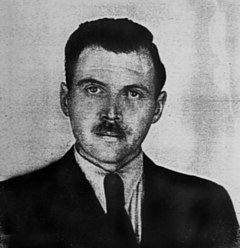
Josef Mengele experimented heavily on twins in the Auschwitz camp. He apparently was a hereditary biologist before the Nazi regime and was given the power as the camp doctor to do what he wanted. He'd separated the twins out from the masses heading for the chambers and be nice to them and give them candies. And then the next moment shoot and dissect them while their bodies were still warm. Or working on them while they were alive without giving them any anesthesia. We've read some pretty gruesome things in this class, but Mengele takes the cake. He's truly what nightmares are made from. I won't scar you all with the details of his human experiments. But it goes back to a theme I've seen discussed by classmates a number of times now. It's frightening what a person can do when given unlimited power and authority over others.
This guy just makes my skin crawl. I read about a number of real serial killers and others for this class. But there's just something about this guy that feels so much worse than most. I just don't understand how someone can be "nice" to the kids one second and then so brutal the next. The best explanation I can come up is that he really, truly, believed that they weren't humans at all. Nothing more than blades of grass.
Throughout this class I've tried to find something of value to take from the real and fictional stories. More than just what I can learn about the craft of writing. My wife is always trying to help me see what positives can come out of such destruction. That was kind of the tone of the afore mentioned special on the History channel. No question, the Nazi regime was horrible. But the special focused on the advancements for all of humanity in the form of science and technology. Recording devices leading to our DVDs, or weapons leading to the jet engine and rocket technology to name a few. The best I can come up about Mengele is that the rest of the world can be warned about giving someone too much power. But I'm sorry, that's not enough. It's disgusting that one, there are people in the world who think they can get away with anything, and two, that so many of them have gone unpunished. Or unpunished for a while before getting caught. Or getting caught but able to live a quiet life in prison instead of being punished the way they should be. Oh, wait, that doesn't sound Christian does it. Well, on this point I refuse to back down.
Tuesday, November 6, 2012
The Killing Joke- DC Comics
While I love superheroes, I never collected any comic books until after high school. Most of what I know about the legends of Batman and the Joker is from Wikipedia or my friends growing up. Approaching this comic in the mindset of this Readings in the Genre course I was intrigued not only in Joker's backstory but also in what he was trying to do. He's trying to corrupt Gordon. It's just like the move the Dark Knight. All he wants to do is corrupt the Batman by any means possible. He'll do whatever he can to break someone down. In the movie, all he corrupts is Harvey Dent. Batman gets close when he uses the cell phone technology to find the Joker. But in the end he leaves the power with Fox because he knows that the power is too powerful.
So in The Killing Joke we see the question I've wondered for years. How will it end? Will they kill each other? This graphic novel isn't just about trying to break down Gordon. It's proving the point that "everyone is just one bad day away from crazy." Both the Joker and Batman have horrible back stories. But we see the differences in their paths. But here's the really interesting point. The Joker was already planning on crime even before the tipping point. So it's not necessarily just about the bad day to turn someone. That's why Gordon doesn't crack. That's why he's determined to bring the Joker in "by the book." Because his mind was set before he's tortured. And it's the same with the Batman. Bruce, the man, stands back at the beginning of the novel and asks how two people who don't really know each other can the each other so much. And I think we hear regret in his voice. All the origin stories for Bruce Wayne involve a desire for vengeance. But not death. It sounds like Bruce is getting tired of the fight as Batman in this novel. But even in desperation Bruce overrides the vigilante Batman for reason. It is more important to bring the Joker in the right way.
And therein is the failing in the Joker's plan. He doesn't understand that it's more than just the "bad day." It's the strength of character within the person and the decisions they've made before that "bad day" arrives. That is why the Batman cannot be corrupted. Because as dark as his life may be, Bruce still holds out on hope. Why else would he approach the Joker at the end of the novel and offer the hand of friendship and love to help the Joker change?
Ultimately, I loved this. It wasn't what I was expecting. But I'm not that experienced with DC comics as I am with Marvel. But I thought this was a great insight into their characters and motivations. Definitely dark in places but a fun end for the assigned readings.
- Posted using BlogPress from my iPad
Friday, November 2, 2012
Building momentum
It's been a long journey to this point. My current WIP is something I began thinking about many years ago. It was the subject of my 2010 NaNoWriMo victory. But I didn't like what I had so I scrapped most of it. I loved the idea and premise. Just not how I executed it. In January 2012, I started my first term as a graduate student with Seton Hill University. My thesis is a novel. So, I brought out Angels of Might and Mercy as a possibility. It didn't go over very well. But I'd expected that because I didn't like a lot of what I had. I like the idea of immortal beings protecting mankind but I didn't want to have such a religious tone because that limits the marketability.
After many month of rewrites, I think I have a better start. Of the 90k words I've written, I got to only keeping 11k in the fourth attempt at starting the novel. And this time it feels good. Thanks to NaNoWriMo (some of the best motivation I've found) I'm up to 15500 words for the WIP which is 3950 words in two days for the competition. I hope that the 50k word goal for NaNoWriMo will help me get further through the WIP so I can spend more time in my graduate course revising the story.
After many month of rewrites, I think I have a better start. Of the 90k words I've written, I got to only keeping 11k in the fourth attempt at starting the novel. And this time it feels good. Thanks to NaNoWriMo (some of the best motivation I've found) I'm up to 15500 words for the WIP which is 3950 words in two days for the competition. I hope that the 50k word goal for NaNoWriMo will help me get further through the WIP so I can spend more time in my graduate course revising the story.
NaNoWriMo 2012 and WIP update
Yes, on top of everything else I am doing another year of NaNoWriMo. Hopefully I can get this WIP close to completion for a first draft.
Current WIP word count
13311
- Posted using BlogPress from my iPad
Current WIP word count
13311
- Posted using BlogPress from my iPad
Monday, October 29, 2012
Joyride by Jack Ketchum - response
The latest work for my Readings in the Genre course at Seton Hill is Joyride. Yep, nothing with joy there. Just a psychotic, murderous, rampage for 200 pages. I did not enjoy this at all. I will try to focus on what I have learned as a writer and how to craft a villain.
First, an interesting quote towards the end of the novel:
"A victim will do some crazy things to stop being a victim, and maybe you did, too. But that doesn't make you crazy, and it doesn't make you evil." (page 190 Nook version)
I'm not surprised to see this at the end of the novel given what we were discussing over this last week in class. What is the definition of crazy or evil? The real truth we found is that all things are in the eye of the beholder. As a Christian, my beliefs of what is evil is defined by the doctrine of Christ as revealed through the ancient prophets, himself in the New Testament, and as revealed through his living prophets today. But I had to step out of that for a minute to examine the villains in these stories. There is a simple matter of perspective and upbringing. My Christian upbringing teaches me one thing but a Muslim upbringing would teach me something different.
I did not like how nearly everyone in the novel is damaged. I was going to say "messed up" or "evil" but stopped myself because that is my perspective. But it did feel like every character was deeply flawed. And not just flawed in common ways like low confidence or something like that. It felt like everyone had a history of abuse or abuser. Usually sexual and physical but also neglect. Now, my undergrad was Sociology so I know that studies are showing a rise in physical and sexual abuse and I'm not downplaying the severity of those crimes and what it can do to the victim. So, I don't really blame what Carol decides to do in the novel. Especially to find that she had a history of this victimization since childhood. But it got to the point in this novel where I didn't want to continue because it felt forced. I bet that was a method for the writer to really drive home Wayne's purpose. But he's pretty messed up as it is. (Think of the closet).
So I didn't need to have what felt like all the other characters involved in abuse of some kind. I think it could have been fine to give the other characters some attribute that bothered Wayne to the point of retaliation. I have wonderful neighbors. I trust them to babysit my girls. But I hate their dogs. And I'm a dog lover. Just not theirs. That's similar to Wayne and Roberts. What I'm trying to say is that from my perspective, it felt like every person in the novel had a blaring streak of evil. Even Lt. Rule. I just don't think I needed such deep wounds in all the main characters. I know that drew a commonality between them to tie them all together for Wayne. But they started blending together instead of being individuals. As the hero of the story, I'm fine with him having a flaw to make him more human. Maybe I just read this novel at the wrong time in my life because it was really depressing. I know we all have our past baggage. And current baggage for that matter. I certainly do. But it was too depressing reading about all the abuse. I know it's out there but I have absolutely no patience with abusers. So I found it hard to read the novel for that alone.
Here's the other thing I've noticed over the course of these readings. I'm fine having an uber-villain in the story. And I thought I wanted to know more about what was going through their head and their motivations. But I've found that for myself. I'd rather keep them more as an enigma that the hero must conquer. In my writing I'm all about deep loss and struggles to force out of my character the best they can be. Because I know that life can be hard! And I think there is more value in find the character who overcomes all odds to stand up in the end, victorious, over their trials. I think that is what many people need. Someone, whether real or fictional, that encourages them to greatness. It is for that that I don't understand the people who read about killers for the sake of diving into their lives and worshiping psychos.
So, ultimately, I have found the importance of finding a balance when writing about villains and heroes. The balance, for me, is finding just how much do you NEED to write about the villain to get across the idea that they need to be taken out by the hero? How much is too much? I generally right dark fantasy as the darkest I go. Not straight up horror. So, I may be pulling back on the details of my killers so that I'm telling just enough without crossing the line into what I consider horror.
Thanks for listening to my ramblings. Now, off to my day job.
Thursday, October 25, 2012
"In a world like this"-response to the film Seven
"It's dismissive to call him a lunatic." This line along with the title of this post really struck a cord with me in this film. Our prompt in our class forum asks: What makes a person's
actions "evil" or "psychotic?" What's the real
difference between insane and sane? So, I'd like to open that up more here.
John Doe feels justified in what he's doing. He is on a mission to remind and expose the evils in the world one heinous sin at a time. Morgan Freeman's character confesses his fear of being a father and "bringing up a child in a world like this" early in the film. I think that definitely sets the tone for the whole story. Doe sees the evil in the world and clearly feels that it needs to be exposed and punished. Needless to say that is an extremely dangerous motive. Throughout history he have stories of people acting under the instructions of their God or for a higher purpose. Why is it we are more willing to accept their stories if they happened in ancient writing and not now? Is it just hindsight that allows us to accept their stories. If John Doe really existed in our world, how would he be viewed in 5, 10, 50, or 100 years. History books are written by the victors. With the information written now about Bundy and others, I don't see how they could ever be seen as anything other than evil. But when you have a person like Doe who views himself as a preacher, would people in the future ever see him as anything other than a killer? I can't even begin to answer this because it all depends on what values society will hold. George Washington is a hero to the USA but was viewed as a rebel and criminal to the English in the 1700s. But how do they view him now if at all?
John Doe feels justified in what he's doing. He is on a mission to remind and expose the evils in the world one heinous sin at a time. Morgan Freeman's character confesses his fear of being a father and "bringing up a child in a world like this" early in the film. I think that definitely sets the tone for the whole story. Doe sees the evil in the world and clearly feels that it needs to be exposed and punished. Needless to say that is an extremely dangerous motive. Throughout history he have stories of people acting under the instructions of their God or for a higher purpose. Why is it we are more willing to accept their stories if they happened in ancient writing and not now? Is it just hindsight that allows us to accept their stories. If John Doe really existed in our world, how would he be viewed in 5, 10, 50, or 100 years. History books are written by the victors. With the information written now about Bundy and others, I don't see how they could ever be seen as anything other than evil. But when you have a person like Doe who views himself as a preacher, would people in the future ever see him as anything other than a killer? I can't even begin to answer this because it all depends on what values society will hold. George Washington is a hero to the USA but was viewed as a rebel and criminal to the English in the 1700s. But how do they view him now if at all?
Friday, October 19, 2012
Responding to "The Sculptor" by Gregory Funaro
"And so it was" that I am disappointed in this one. For those that read this one, did you notice how often he used that phrase? It started to grate on my nerves. Queue a pause in reading and a review of my manuscript for over used phrases.
I came into his book with a lot of hope. To date I had heard about Psycho, Hannibal Lector, and Stephen King. But, I hadn't read them before this class. But, so far, the only pieces I hadn't heard about at all were Church of Dead Girls and The Sculptor. Based on our fearless leader, there's a reason for that. I felt like this had a lot of potential but there were too many things that just felt..... blah. Seriously? He's super strong? But a recluse as well. That didn't feel believable. Now, I'm not saying that Dan Brown's books are the best, but, in the aftermath of his Angels and Demons and DaVinci Code novels, I really felt like this was trying to ride on the coat tails of that success by bringing in the symbolism and art masterpieces for the villain. Especially since when a single, beautiful, expert on Michelangelo is there to help the authorities. Yeah, it just felt too similar. And at parts it felt like a personal love letter to Michelangelo.
But, what the villain does to the victims was definitely intriguing. I don't claim to be well versed in horror and murder stories but I don't think I would have ever thought to turn victims into pieces of art. That definitely takes a unique look at life and art to have come up with that. While I didn't like the novel as a whole, it was interesting to see how someone can fixate on something. Our last book it was Annie Wilkes fixating on Paul/Misery and Paul fixating on finishing his novel. This it was his work. I think that is a very telling attribute to psycho killers in life and fiction to see how many of them view what they do as "their work?" That in of itself opens a wide world of psychosis and study.
Friday, October 12, 2012
African cockadoodie oogy dirtie birdie: A response to Misery by Stephen King
Ummmmm.... yeah. This was an interesting one. Misery is the first Stephen King book (aside from On Writing) that I've ever read. I like the style and the story idea. It's creepy and there were many times when Paul is struggling to write that I wondered if that was autobiographical for Mr. King. He certainly captures my plight as a fledgling writer.
It took getting about 2/3rds through the novel before I realized why this one bothered me more than Psycho, Church of Dead Girls, Red Dragon, and Silence of the Lambs combined. And then it dawned on me. Misery is written from the point of view of the victim! I internalized it more and it freaked me out more. I honestly can't say that I would have tried to last as long as Paul did. That is partly what I feel is unbelievable about Paul. He's unconnected from everyone yet he finds a reason to stay alive for so long. I have a wife and two kids and I'm still close to my extended family. I'd only keep going because I wouldn't want them to have to deal with my death. I wouldn't be fighting to stay alive for myself or for a "cockadoodie" story. But, as the novel progresses, I can understand to a point why he's so attached to finishing the novel.

It took getting about 2/3rds through the novel before I realized why this one bothered me more than Psycho, Church of Dead Girls, Red Dragon, and Silence of the Lambs combined. And then it dawned on me. Misery is written from the point of view of the victim! I internalized it more and it freaked me out more. I honestly can't say that I would have tried to last as long as Paul did. That is partly what I feel is unbelievable about Paul. He's unconnected from everyone yet he finds a reason to stay alive for so long. I have a wife and two kids and I'm still close to my extended family. I'd only keep going because I wouldn't want them to have to deal with my death. I wouldn't be fighting to stay alive for myself or for a "cockadoodie" story. But, as the novel progresses, I can understand to a point why he's so attached to finishing the novel.
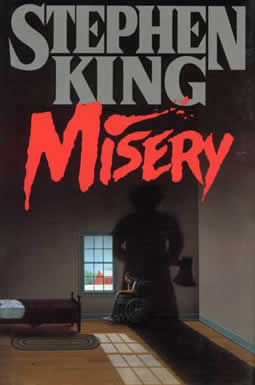
Photo from http://www.stephenking.com/library/novel/misery.html Creepier cover than the one on my Nook book version in my opinion.
Annie Wilkes was pretty creepy to begin with. Super fan to the extreme. Yeah, then she dumps soapy water in Paul's face forcing him to drink it. Oh, and then shattering his already busted knee! So I was pretty convinced that she's psychotic. And that's all before Paul sneaks a peak at her book of memories. I screamed at him to get back to the room every time he "thought" he heard a car coming. I can't remember the last time that I actually vocally yelled at a character in a book! Mr. King, I applaud you and your astounding story-telling abilities. I didn't fly through this book like the others because it was more painful to read. Not that anything was wrong with the story, craft, grammar, etc. As I said earlier, it was simply because I internalized Paul more than I internalized Will Graham or Dolarhyde for example. Now I understand why our fearless leader, Scott Johnson, warned us at the beginning of his syllabus for this course.
I'm struggling to find ways to articulate how this affected me. It will lend to interesting reads from my classmates as they post their reviews (see horror blog roll on the side). One thing I can say is that I can see now why Mr. King has such a following. We've read a number of scary stories in the class so far. Most of those just intrigued me with questions like "How does someone get like that?" Misery didn't do that as much for me. If I questioned anything it was "Would I last as long? Don't think so." I seriously think if I had been in Paul's place I would have succumbed to the pain and horror long before I found out about Annie's past. Just goes to show what a tale you can make by putting your character through some truly horrific situations.
Monday, October 1, 2012
Responding to Silence of the Lambs
My latest foray into the criminal/psychotic mind is a follow-up to Red Dragon by Thomas Harris. I haven't read the novel Silence of the Lambs but I was pleased to see that what I was wanting from the novel Red Dragon was present in Silence of the Lambs. That being Hannibal Lector. I am aware of his cultural significance as the modern Dracula. I was therefore intrigued to literally see him in action. Wow, I knew Anthony Hopkin is a very talented actor but his portrayal of Hannibal Lector, in my opinion, is stunning. Truly creepy.
There were some questions that I still have about the character. Much of my focus in this Readings in the Genre course is on motivation in the killer. I got the impression between Red Dragon and Silence of the Lambs that Hannibal is an elitist without any sympathy for others. But, Anthony Hopkins shows some emotions for Lector that I hadn't expected. When he's questioning Clarice Starling about her past, he turns away from her and as she tells him about a painful experience his expression appears to be one of compassion. Not lust and hunger for pain as I expected. I think it's compassion because when Lector finds out that Starling had made up the deal with the Senator without the Senator knowing he doesn't get angry with Starling. Instead, by the end of the movie, he "wants to keep her in the world" and goes after Dr. Chilton. That boggles my mind. How can someone be so disturbed as Hannibal Lector but then apparently show compassion to Starling? I guess it is similar to Dolarhyde trying to protect his new love instead of satisfying the Dragon.
The effect on the audience is clear. Give the villains something that we can relate to and our hatred for them declines. We may even get to the point of sympathy. You could actually see something like remorse in Buffalo Bill at one point. If not remorse then at least discomfort. Did he only feel it with the senator's daughter or did it feel it with any of the others? It's like what has been discussed by my classmates regarding the Red Dragon. Who among hasn't, at least once, struggled with our own body and appearance. Both Red Dragon and Silence of the Lambs have individuals who struggle so much with what they were given at birth that it drives them to drastic measures. I don't think Thomas Harris was trying to say that everyone struggling with their body has the potential to kill. But, it is food for thought that there are so many commonalities with killers and their past.
Thursday, September 27, 2012
Red Dragon response
I really liked this one. And no, I'm not just saying that to kiss up to my instructor. I've been trying to find something (no matter how small in some) in all the books we've read for the Readings in the Genre course that I can apply to my own craft. Before I get into the "what I learned about the writing craft" from Thomas Harris, I wanted to say that for the most part I really liked this story. It felt more like a psychological thriller in that the two families destroyed by the dragon have already taken place by the time to book starts. What follows is a story about Francis and his psychological issues with some great psychological insight into Will Graham. There was something I didn't like about the ending which leads me into craft.
I guess I was reading this story as a mystery and not just a story about a killer. I felt like I "saw it coming" when Francis fakes his death to come after Graham. Not really because of any clues in the story so much as I saw on my nook that I had too many pages left after Dolarhyde's house explodes for the story to really be over. So, to me, it felt like Harris stopped telling us a story and just went for a shock factor finish. It felt cheap to me and left me feeling cheated.
I've said in past posts on other books as well as in discussion in class that I stress a lot with motivation for my killers. This just proves to me the recent revelation I made for myself as a writer that you can't aim to please everyone when trying to create a plausible backstory and motivation for a killer. Personally, while extremely traumatic for Francis, I didn't feel like there was enough motivation for becoming the Dragon or in stalking his victims. So, again, I can basically give my villains any backstory I want that will result in their motivation. All the really matters is staying consistent with that motivation for the character throughout the work.
Monday, September 10, 2012
A review of Church of Dead Girls
I most likely would never have heard of this book if I wasn't taking this class for Seton Hill. I learned a lot about the craft of writing and story structure from this and will respond accordingly.
Craft: Point of View
A problem I had with Psycho was that there wasn't enough detail on the psychosis and mentality of Norman Bates. I wanted more than what was given. Then I start reading Church of Dead Girls and I'm drinking out of a fire hose with the information on almost every single person in the town! It really felt like two extremes. But, here is what I didn't like about the narrative in The Church of Dead Girls.
The POV shifts in a way that I feel like we've been told not to do as writers. Sometimes it is first and other times is third. That can be okay. But, there are many times where the narrator is telling us a thought or emotion in a character that he wouldn't have known that unless he was inside their mind. I know the story is all told from after the events have occurred and after many interviews. However, it was a little annoying to occasionally have something said that could not have been known by the narrator no matter how many interviews.
Craft: Villain creation
Motivation: This is always an area of concern when I write. I need the motivation for my villains to be believable. I can't stand the movies and stories out there where the villain just wants to destroy the entire planet. What's the point? You'd be dead with everyone else! But, this novel taught me a lot about motivations.
The Friends group are motivated by fear and revenge. The IIR are motivated by making a statement when they push over the headstones. Donald, is motivated by a need to purge and purify. There are many other examples and depths of character but something finally nailed home to me when I finished the book. Perspective.
My upbringing leads me to a particular perspective while yours will lead you somewhere else. At the end of the book we learn that there are members of the community who don't fault the members of Friends who destroyed Paul's home. But, yet, they find fault with Dr. Malloy for shooting his brother. I see it the other way around. I support Dr. Malloy because he was willing to look beyond family to stop a killer and I condemn the Friends for destroying Paul's home and going against the police. But, then again, how many of us (parents especially) wouldn't be itching to rip apart every inch of the town to find our own child or to prevent any more children from vanishing. I'm the first to admit that in the case of protecting children I'd personally give up my own rights to ensure their safety. I can't force anyone else to do the same but I could sympathize with the fear and anger of the community in Church of Dead Girls.
So, this is the mind boggling nature of the mind in people and eventually in creating your own characters. You really need to know their perspective to know how they will react to situations you put them in in the story. I've been so focused on making a motivation/back story to my villain that everyone (audience) will accept. But, that's just not possible. Because everyone has their own perspective. Two people can have the exact same childhood, abuse, neglect, etc. But, they may not turn out the same in the end. One can become a saint and advocate for preventing such treatment of children, while the other can become psychologically damaged by their upbringing and exhibit the same behavior they were a victim of in childhood. The mind is a curious thing and how we as individuals (or our characters) chose to respond and react is what is so fascinating to me.
So, instead of trying to find that one motivation for my villains that everyone will accept, I need to focus on the character individually and decide how they will react with their own back story that will result in their future. So many complexities.
Monday, August 27, 2012
Psycho: A Novel -Robert Bloch
I recently read this novel for a class I have at Seton Hill University. I came into it knowing the basics of the story. I knew the truth about Norman Bates and had only seen the shower scene from the movie. So, the end was spoiled for me. But, honestly, how many people didn't know what happens in this story?
I was disappointed that there wasn't more content on Bates. But, for a short novel it did well. I'm intrigued on the grief aspect that drove Bates to continue to act as though his mother was alive. It's just such a wonderful blend of what can happen mentally in a person to deal with situations in their life.
Last night, my wife and I were talking about the Life of Pi. She hasn't read it but saw that it's going to be a movie soon and asked about the premise. This is another example of what the mind can do in a person to help them deal with their experiences. I'm still inclined to believe that the boy in Life of Pi really was on the boat with a tiger. (SPOILER WARNING) But, it is suggested that he was actually on a lifeboat with a man who engaged in cannibalism and how the character chose to deal with that situation. Again, while I believe in the literal experiences of the character it is intriguing that the medical professionals at the end of the book could see the possibility of him creating a different situation to make what he experienced more acceptable.
So I compare Bates and Pi together and I'm even more fascinated about the human mind and potential. Bates didn't like who his mother was dating so he killed them and then blocked that event from his memory and believed that his mother was still alive. Even if the character in Pi wasn't really with a tiger, zebra, and baboon, he interpreted the other people as the animals as a defensive mechanism to deal with cannibalism in the man he associates as the tiger. All I can say is wow. Both characters were young when they faced these situations. But one was faced with life or death and managed to survive without losing his humanity while the other (Bates) just didn't like who his mother was dating and clearly went off his rocker by killing numerous people.
What is it that really drives someone to that point? You get the feeling that Bates was very sheltered. His mother never liked what he read and he seems to only have able to read what he wanted after he had killed his mother. Yet, even sheltered, he was able to carry out murder. The kid in Pi lived in a zoo. He saw nature in a somewhat raw form. He watched the tiger kill and eat the zebra and baboon. But, having grown up around animals who kill for their food and all the potential disturbing images that would result, he didn't go insane.
Ultimately, that is what intrigues me the most about killers in reality and fiction. How can two individuals go through traumatic events and one comes out "normal" but the other becomes a killer? It's something I think about a lot as I create my own villains. What do I need to put them through to become the villain I need them to be? What do they have to experience to become a thief, killer, etc? There are so many variables that influence our decisions. That is what makes writing villains so fun and such a headache at the same time.
Subscribe to:
Posts (Atom)